Kierkegaard vs the Modern World

(A Review of Sylvia Walsh’s Kierkegaard and Religion: Personality, Character, and Virtue)
Soeren-Kierkegaard-kar

Søren Kierkagaard is a difficult thinker in more ways than one. Not only is his writing full of abstractions and speculative notions and references to Hegel, but he also makes a number of provocative arguments that can be rather hard to take. Reading Kierkegaard, you will be assailed for your complacent modern beliefs in objectivity, virtue, and individualism. Kierkegaard doesn’t care about pleasing his readers, at least not all of them. He just wants to get through to those few who stand a chance of transforming themselves into real authentic human beings.

Sylvia Walsh’s book (published 2018, Cambridge University Press) is valuable above all as a brilliantly clear account of some of the central ideas in Kierkegaard’s thought, bringing this difficult thinker to life for 21st century readers. But at the heart of this book is a purpose: to show that religion is necessary for the development of the individual. This was Kierkegaard’s central belief, and Walsh thinks it is essential to comprehend the truth of it today.

We live in a time where religion seems to have less and less significance. So Kierkegaard’s message goes against the grain. And there are other ideas in this book that pose a challenge to the popular ideas of our time. The three I’m going to focus on are:

  1. Personality is something that is acquired, and not everyone has one.
  2. You are not owed anything for your virtuous thoughts and deeds. (Which means: doing good works does not merit God’s grace – p.100)
  3. There is too much concern with “objectivity” in the world today.

For Kierkegaard, personality is something that was sadly lacking in the modern individuals of his day. And Walsh demonstrates that he would find the situation today no better. The modern view – and arguably even more so the postmodern – would have it that personality is something given, wholly given by the social forces that shape you. Against this view, Kierkegaard argues that having a personality is not something guaranteed at all, it is something you acquire individually and only by hard work, and is in fact something that very few people achieve in a whole lifetime.

In an age of individualism, particularly in a consumerist society, personality is taken for granted. Everyone has their dispositions, likes and dislikes, and so on. But to define an individual based on shallow traits in this way is to be too objective about things, as if an individual was just made up of characteristics that you can put into a spreadsheet. Real individuality has to do with “inwardness” – in other words with the very real subjective struggle of the individual. And the precise nature of any individual’s struggle can never be wholly communicated to anyone else.

“By a person or personality he means a solitary I or distinctive individual, which every human being is originally created to be and has as one’s specific purpose in life to become.” (2)

The reason personality is so lacking in the modern age is that people tend to neglect this realm of subjectivity, and believe that everything important is objective and empirically verifiable. There is nothing “solitary” in the modern age – nothing that cannot and should not be brought into the cold light of the public eye for scientific cross-examination – and so the idea of undergoing any kind of personal, secret, and unique spiritual trial is not something that would ever seriously occur to most people. Without an awareness of the subjective side of things, it is impossible to even become aware of the possibility – let alone the necessity – of the greatest human task: to struggle inwardly to acquire and develop a personality.

Objectivity is a big problem then, for Kierkegaard, since it distracts us from the realm of the personal, which must be taken seriously if we’re ever to undergo the spiritual trials required to develop ourselves. But before I say more about objectivity, let’s look at the concept of “merit.”

Another unpopular view that Kierkegaard holds is: no reward is owed you for your good behaviour. For Walsh, this is what makes Kierkegaard different from most virtue ethicists. A virtue ethics will usually teach what virtues it is necessary to hold in order to live the “good life”. Kierkegaard, on the other hand, does not think that it is possible to avoid either evil or suffering in this life: as a Christian thinker, he believes that we are all sinners and so cannot avoid evil except by God’s grace; as an existentialist he believes that life is an ongoing difficult task, and so suffering is unavoidable. According to Walsh, this is a point of view he shares with Martin Luther:

“According to Luther, human beings do not merit salvation at all but receive it wholly on the basis of God’s grace. Nor is divine grace earned by becoming virtuous via human agency, which in his view is enslaved to sin and can do no good on its own.” (78)

Kierkegaard does recommend cultivating a certain kind of attitude and behaviour in order to be a good Christian – “morality, inwardness, obedience, continuity, service to the unconditioned, unity of the self …” (73) – he just doesn’t think that the reason for being this way is to ensure personal happiness. Eternal happiness is, in the end, guaranteed anyway to everyone, whether they make an effort or not, since “the eternal is essentially present in every human being.” (149) And even if you are one of the few that makes an effort, the only reason you found the strength to do so was by God’s grace.

By taking merit out of the equation, God’s grace becomes something mysterious: it’s not a balance sheet of rights versus wrongs, with the total determining whether you receive eternal happiness or eternal damnation. The nature of grace is something you only get a sense of in a personal and subjective way. A secret that cannot be communicated between human beings because it does not have the objective character of a ledger of accounts.

Once again, we come back to objectivity. Reading Walsh, I get the impression that objectivity is the big issue for Kierkegaard. She tells us that Kierkegaard believed that both objectivity and subjectivity must be taken into account when thinking about how to be a good Christian, but that modern times are so biased in favour of the objective that Kierkegaard decided to go entirely the other way, in an effort to redress the balance.

For example, objectivity would include “the objective standpoints of historical scholarship and speculative thought.” Academic study, including philosophy, tends to strive for the objective: What is…? questions are looking for definitions and proofs that can settle matters once and for all. The problem with this approach is that it leads one away from faith, which Kierkegaard believes is essential to the Christian character. (45)

Subjectivity, on the other hand, means “an act of isolation” and “an essential secret that cannot be distinguished outwardly or communicated directly.” (45) Subjective truth is “an objective uncertainty, held fast through appropriation with the most passionate inwardness.” (46) You can see that Kierkegaard is emphasising an act here, a mark of character: the act of holding onto something uncertain and mysterious. Objectivity destroys the possibility of such an act by effectively making everything too easy: if you believe in God because you find it to be an objective and irrefutable truth that He exists, then you will not need to adopt the position of a person of faith, and so will lack an essential component of the Christian character.

Much is written and spoken today about the selfishness of human beings under capitalism. A common modern explanation for this is that we’re too individualistic – but Kierkegaard tells us quite the opposite. What we are lacking is real individualism. The “individualism” that we see around us is of an objective kind, based on shallow traits: likes and dislikes, and so on. Yes, human beings display selfishness, but this is because of a lack of real individuality and character, which would mean realising that material wealth has nothing to do with the highest needs of human beings. With the modern individual there’s no emphasis on “inwardness”, on the subjective struggle, on the work that every individual must do alone in order to actualise themselves as a human being. There’s good reason that inwardness is so rare, of course: as we’ve seen, for Kierkegaard the inward is a “secret” that it is the purpose of life to discover.

Walsh ends her book with some reflections on the present day:

“While differing from the modern age in some respects, the present age has seen an increase in social levelling, and a corresponding further decline in religious belief and practice. This has resulted in massive secularisation and the creation of what philosopher Charles Taylor has aptly described as a closed or immanent social and moral order dedicated to the pursuit of human happiness and individual flourishing without any sense of the presence or transcendence of the divine.” (178)

And though I am not a believer myself, I did get an overall sense from reading Walsh that in the present age we’re missing something in our secular pursuit of happiness. Kierkegaard tells us that what we’re lacking is awareness of our relation to the divine, and perhaps this is precisely it, if by “divine” you mean something personal, in other words that only you can relate to, that gives life meaning and defines you as an individual. What we’re lacking is a sense of individual meaning, when we focus on happiness too much.

And Walsh points to evidence that things seem to be going wrong: for example the growing disparity between rich and poor. It’s ironic that the kind of “social levelling” that we see today, a kind of confused belief in meritocracy, seems to be doing little to alleviate the suffering of the world’s poorest, and may in fact be making things worse.

Look around and ask yourself: does it seem that we’re focusing on what’s important? If not, then it might be worth considering that humanity lost something when it started to outgrow the concept of religion.

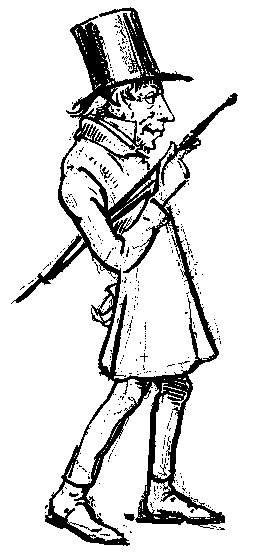
(Image is from Wikimedia Commons)
Posted in books, Reviews of 2018 Books | Tagged , , , , , , | 5 Comments

Truth in Writing

Occasionally people will ask about Henry Miller: was he even a real writer? Wasn’t he a fraud who fooled the world into believing he was the real thing?

Miller’s books are, on the one hand, like nothing else that had ever come before: sprawling and spiralling things without beginning middle or end, so that nothing he wrote could ever be called a “novel” or even really an “autobiography”. Miller found himself unable to write a story and so he played to his strengths and created his own way of expressing himself in writing.

On the other hand, Miller’s books can seem derivative of the avant-garde that had arrived long before him – Dada and Surrealism, for example – so that you could ask yourself: What did Henry Miller really contribute as an artist?

Miller’s books speak to me directly as almost no other writing does. And so I know that Miller was the real thing. But it’s interesting to see that Miller doubted himself as much as his critics did.

He knew that he was capable of lies and fraud, and he spent a lot of time bluffing his way through life before he succeeded as a writer, as we see in his “Rosy Crucifixion” trilogy (Sexus, Plexus, and Nexus).

The elevator attendant in Chapter 7 of Nexus is bizarrely rude to Henry. We wonder what exactly his problem is. Still, it’s strange to see Henry march back up to him and confront him with “Why do you hate me?” It seems like a sure way to start a fight.

But the encounter is quite revealing. The elevator attendant, a war veteran, has seen through him, he says. He knows a fake when he sees one, and literally has the scars to prove it. Henry is terrified and feels that the man has seen right into his soul.

After the encounter, Henry wanders the streets in a self-pitying mood. He’s now wondering: Does everyone despise me? Have they all seen through me? He’s thinking about the many acquaintances he’s made in his life and wondering what each one of them really thinks of him.

It’s a version of Miller we’re quite used to by Chapter 7. In Nexus, so far, Miller has been mostly weak, self-indulgent, and even suicidal. He’s looking in the window of a gun shop when a hand slaps him so loudly on the back that he thinks for a moment that one of the guns has gone off.

Tony Marella is pleased to see his friend and is sorry to hear he’s down on his luck. He offers Henry food and drink, and even a job. Tony gives his friend reassurance too: you’re born to be a writer, and your time will come one day. “And just when I thought the earth was ready to receive me,” thinks Miller, along comes a friend to help him.

It’s not just the food, drink, and money that revive him. Tony has come at a vital moment because Henry doesn’t have to pretend with him. He doesn’t have to compromise: Tony knows that Henry will be a writer one day, and just wants to help his friend out.

For all that Miller may have used tricks to get by – both in his writing and in his daily life, borrowing and stealing – we see throughout Nexus what it is that he really wants: to find the truth in himself and express it to the world. He is miserable for as long as he is forced to lie and pretend and play a part, and he has to become a writer not because of the expectations of others – since almost no-one expects him to succeed anyway – but because he must do it for himself, to raise himself up to a higher spiritual level. He needs to be able to tell the truth, and to live truthfully.

Miller’s books are an answer to a serious question he posed for himself, and answered truthfully as he could: Who am I? And because he struggled honestly, earnestly, and for so long with this question, a question we all ask ourselves from time to time, he was able, finally, to write books that are really worth reading.

Posted in books | Tagged , , , , , | 2 Comments

Notes on Nexus, Part 3: Finding Love

Chapter Three of Henry Miller’s Nexus is about despair. Miller describes his desperate state, trapped in a harmful relationship with Mona. He spends his days doing nothing, letting “events pile up of their own accord.” He knows he needs a miracle to save him, but he cannot muster the energy to bring one about.

His despair is of his own making, and he created it out of fear. He lives always in the “now”: because the past is lost to him, and he does not dare to hope for any future. The fear from which his despair is built is terrible because it is fear of one thing and one thing alone: losing Mona. His cowardice has made him brave: he has annihilated everything and will face any danger in order to avoid the one thing he fears. He has retreated into his mind in a desperate bid for survival, believing that survival is only possible if he can keep his love for Mona alive, even if only in his own mind.

In his despairing state, he believes that pure love is impossible. And yet love is essential to life. So he has had to make do with an impure, human love, fragile, which has made a coward of him, fearing as he must for its survival. So many things can destroy an impure love: loss of feeling, sabotage by a rival, death of the beloved. Pure love means letting go and letting the loved one be, but this is impossible for beings who are “weak, proud, vain, possessive, envious, jealous, unyielding, unforgiving.” And we are all those things some of the time. And in despair it seems to Miller that that he is only these things.

But even this impure love, this all he has, gives Miller a glimpse into the deeper truth, the deeper nature of love. What love is in its purity. He can imagine the perfect and pure love, and he knows that if only he were capable of this greater love, then even death could not destroy it. He would have nothing to fear.

But though he can see this pure love in his mind’s eye, he knows he cannot reach it. He knows it is there, but it is infinitely distant. He has learned in his despair to live without true love, with only the idea of it in his mind. A literary notion of love, detached from what he actually feels in his human heart.  He is living now a “minus” life, a life lived only in the mind. A life of cold ideas without emotion. Everything of life has faded, he says, because love, which is the essence of life, seems all but lost to him.

The chapter ends with Miller admonishing his past self for having fallen into this wrongheaded thinking. Why look to the stars for the ideal of love when life is all about us? Why pray for the intervention of angels when you can go into the street and find one in human form? And yet this period of inertia was a necessary step in Miller’s development. With this fall into the very depths of despair, Miller learned something of the darkest side of human existence, the very subject matter of what he would soon write, after leaving New York for Paris.

Posted in books, Literature | Tagged , , , | 3 Comments

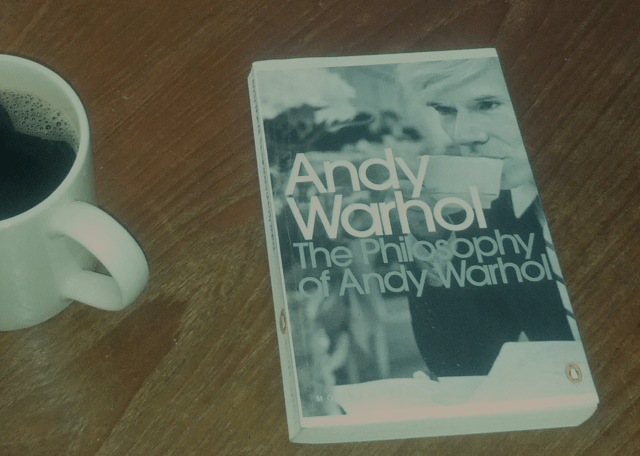
Notes on The Philosophy of Andy Warhol

22 WarholThesis: “As soon as you stop wanting something you get it.” Andy Warhol says that he has found this rule to be “absolutely axiomatic.” He was always lonely and desperately wanted a friend, until one day he decided he was better off alone, and suddenly he had crowds of people chasing after him to share their problems.

He has to choose between professional psychiatric help and television. Television works better. It’s reliable: you switch it on and there’s the sounds and colours to distract you. Psychiatrists are human and so sometimes they disappoint you by failing to understand or not calling back.

“In the 60s, everybody got interested in everybody else.” And this is the problem: you can’t be a loner when everyone is interested in everyone else. Especially if you’re Andy Warhol.

It’s not just his television that saved him. He has a tape recorder too. If someone comes up to him with their problems he can just flick the tape recorder on and their appeal for help and advice, however heartfelt, becomes just a performance for the tape. And listening back to the tapes gives Andy a certain perspective on himself and on the other voices on the tapes that finally kills off emotion for him. “I think that once you see emotions from a certain angle you can never think of them as real again.”

Posted in books, Literature | Tagged , , , | 3 Comments

Henry Miller: Soul and Mind

In Chapter Two of Nexus we see the limits of Henry Miller’s patience with abstract arguments. His friend, a lawyer called John Stymer, is, like Miller, fascinated by Dostoevsky, and thinks that a “new phase of existence” arrived for humanity after the great author’s death. Stymer says that when Dostoevsky died the human “soul” died also, and now all we have left is “mind”. What he means by these terms isn’t exactly spelled out, but it seems that Stymer understands the soul to be something that permitted human beings a certain capacity for greatness, while the mind can respond to life only weakly, by retreating into a defensive position, with survival – or denial of death – its core purpose.

Stymer’s argument is reminiscent of Oswald Spengler, another writer Miller admired. With the death of the soul of a culture – a culture’s capacity to create new things – a civilisation can only decline, until some new possibility emerges from the ruins. This period of decline Stymer calls going “underground”, and likens it to a seed falling into soil. (A very Spenglerian metaphor.) The seed is not yet capable of anything, but wait and, with a bit of luck, it will grow into something with an organic purpose and character of its own.

Stymer thinks that Dostoevsky brought about the death of the soul by exploring every possible aspect of it. In his writing he explored its every avenue until he found dead end after dead end. The soul is “done for” because Dostoevsky has shown us its limitations. We retreat into the infinite depths of mind.

Mind, in its mission of self-preservation, always takes the easy way. Religions of the mind “give us a sugar-coated pill to swallow” by telling us stories that skirt around the hard fact of death. The politics of the mind gives us a similar pill, by pretending that we can be protected from harm by punishing those we call “criminals”, and thereby distracting us from the fact that we are all “tainted with the notion of sin.” Stymer ends his speech by proposing that the clue to the new way of being that will emerge from the soil of the mind might be found here: perhaps something so simple as turning to face the facts of death and human sin might open up the new possibilities for humanity that would bring it to life – or bring life to it – once again. He thinks that, by facing death and sin, we would discover they are made by man and not by God, and therefore we would be able to overcome them once and for all.

Miller is spellbound for weeks after hearing this speech. Stymer has put into his mind this notion of “man the criminal” or “man his own criminal”, and of “man taking refuge in his own mind”, and it starts Henry Miller’s own mind racing. He says: “It was the first time, I do believe, that I ever questioned the existence of mind as something apart. The thought that possibly all was mind fascinated me. It sounded more revolutionary than anything I had heard hitherto.”

And then he hears that his friend the lawyer has died. And with Stymer’s death, Miller’s fascination with his ideas dies too. “With that I stopped worrying about the mind as a refuge,” he writes. Perhaps the death of his friend put all these abstractions into perspective. Perhaps by this time he had made all the use he could of the inspiration these ideas had lent him. It is interesting to read how Dostoevsky put the seed of an idea into Stymer’s mind, who then dropped seeds into Miller’s, which would eventually grow into pages of literature. But as for the metaphysical debate itself, Miller sums up his feelings for it with the final words of the chapter:

“Mind is all. God is all. So what?”

Posted in books, Literature | Tagged , , , , , , , | Leave a comment

American Life Unlimited

Chapter 1 of Henry Miller’s Nexus is about, among other things, the mystery of Dostoevsky and the monotony of New York City.

He finds a line he’s scribbled in his notebook, which he thinks is “probably from Berdyaev.” It says: “After Dostoevsky man was no longer what he had been before.” He starts to think about how Dostoevsky might have transformed the world. He sees the evidence in the parallels between the characters he’s read about in Dostoevsky and the characters he’s met in New York.

“American life, from the gangster level to the intellectual level, has paradoxically tremendous affinities with Dostoevsky’s multilateral everyday Russian life. What better proving grounds can one ask for than metropolitan New York, in whose conglomerate soil every wanton, ignoble, crack-brained idea flourishes like a weed? One only has to think of winter there, of what it means to be hungry, lonely, desperate in that labyrinth of monotonous streets lined with monotonous homes crowded with monotonous individuals crammed with monotonous thoughts. Monotonous and at the same time unlimited!”

It’s difficult to see what Miller’s point is, and he doesn’t go into much detail. But it’s interesting that he saw this parallel. It fits in with the broader point he would make elsewhere, that true literature must be connected to life, and the great authors are the ones who make this connection, by writing works that speak directly to the human spirit. The height of ambition would be to write a book to end all books, so that that writing would no longer be necessary and life could just be lived. This was, in a way, what Miller was hoping to do with Nexus: at long last finish telling the story of “Mona” so that he could be done with writing and spend the rest of his life living and painting.

Miller would never have become a writer in the first place if he hadn’t believed that there exists an essential connection between life and literature, and that the act of writing brings with it a new and deeper mode of living. Not all are born to be writers, but for those that are writing is a necessary part of life. The whole of life, you might say, in the sense that writing is the essence of a writer’s life, giving meaning to every other part. By striving to fulfil his ambition to be a writer, Miller was also striving to live his truest life and be his truest self. No wonder he saw the shadow of great literature in the lives of the ordinary – and extraordinary – people that surrounded him.

Posted in books | Tagged , , , , , , , , | 4 Comments

Notes on Gogol’s Old-Fashioned Farmers

The world is all “in an uproar,” says Gogol. And yet here is peace and quiet: the house of the owners of a small village in the Ukraine, with its bright garden full of trees and hanging fruits, and the pleasant smells of cooking and delicious things to eat.

Even the barking of the dogs is peaceful, so lazy are they, basking in the large garden. Even the squeaking of the old doors of the house is pleasant, each one singing its own song as it opens and closes on its ancient hinges.

The peace here is so deep, how could anything disturb it?

Gogol teases us with different tragic ends the tale might take. What if the house burned down? the old man says. But he is just teasing his wife, who is horrified at the thought, and of course the house does not burn down.

Why shouldn’t I go to war again? says the old man. And his wife scolds him for saying such a thing: he would surely be killed immediately, an old man on the battlefield. And his ancient guns would surely burst before they would fire a shot.

But of course he is just teasing his wife again, and the old man will not meet his end in battle.

And then one day tragedy strikes. The old woman has a premonition that she will die, and soon she is buried. The old man cannot understand it. He lifts his eyes and looks about and asks Why? Why have you buried her?

And there is so little to tell after that. The old man weeps, and the narrator sees that these are no longer tears of passion, but signs of “a heart already growing cold.” And when the old man believes he hears his wife’s voice in the garden calling him to the grave, he almost immediately succumbs, and is soon buried in turn.

The What Ifs in any story are interesting: what if the house had burned down? Would the couple have found a new lease of life elsewhere? And what if the old man had gone to war? Would he have perished, and his wife been the one to die of grief? In these What Ifs are the seeds of new stories, new possible worlds that the writer might have created. But more interesting for me, in this story, is the certainty that the wife feels, at that crucial point in the story Gogol has chosen to tell, that she will die. The writer is able to make us feel that we are witnessing something inevitable, an action carried out by Fate upon a helpless mortal. How does he create this effect?

It is an incident with her cat that speaks as a sign to the old woman. The cat goes missing, running away to live with the wild cats in the wood nearby. And then days later the cat returns half starved. The old woman feeds it, but when she reaches down to touch the cat it runs off: it has become an entirely wild creature now. It is this that she takes as a sign that death has come for her.

I don’t understand why the cat is a sign of death in this story. Perhaps a Ukrainian or Russian reader of the time would have understood. What is important for me is the certainty with which she reads the sign: it speaks to her directly. And the seemingly arbitrary form that the sign takes heightens this effect for me: the message appears as something just for her, something unique. We have no option but to believe that the woman has read something of Fate in the incident. I imagine how much weaker the effect would have been if something that was to me more recognisably unlucky had happened, like a black cat crossing her path, or a mirror breaking. Her belief, in its dreary familiarity, might have seemed superstitious and ill-conceived. Comical even. As it was, she could only have read this highly original sign of the disappearing cat through some definite and highly personal means, written as it was just for her.

It’s this application of the unique and concrete that gives the story its power. The cat must be a sign: so the old woman tells us. I have nothing to compare it to, this unique event, and so it speaks for itself of the mysteries of the universe. And so the power of mystery is given concrete form in Gogol’s expert attention to detail.

(I’ve been reading “Old-Fashioned Farmers” in The Overcoat and Other Short Stories by Nikolai Gogol. The translation was published by Dover Thrift Editions.)

Posted in books, Literature | Tagged , , , , | 6 Comments

Notes on Gogol’s The Overcoat

Gogol’s The Overcoat is a story of a lowly government official in Tsarist Russia. His job is to copy out documents.

There’s a curious ambiguity in the narrator’s feelings for the official: on the one hand he is described as miserable: as a new-born he cried “as though he foresaw that he was to be a titular councillor.” On the other hand, when we see the man grown up there is no denying that he is content in the limited life he leads, and he is passionate about his job, having a special love for some of the words he copies, and dreaming about lines of text even when he is out on the street, so that he feels he is copying even when he is away from his desk. In sum, he is a ridiculous character, but the narrator hints that perhaps it is not so bad to be ridiculous in this way.

He is a man who lives an unassuming, solitary life. An absurd life, we might say, since it seems so devoid of meaning: his mind is only ever occupied with whatever work is put in front of him by other people, and he seems never to have pondered the meaning of life, let alone taken any steps towards wresting control of his life from the hands of others and evaluating it for himself.

A change awaits him, in the form of a new coat, and after this change his past life will seem to have been empty without it. How could life have had any meaning then, before the overcoat entered his life? (I think there have been overcoats in my life, things that changed everything forever and rendered my past life meaningless. Reading Plato for the first time at age 17.)

Suddenly, everything is shaken. A period of transition: things don’t make sense now the way they used to. He is learning to see the world differently. The coat is distracting him from his work so that he almost makes a mistake in his copying – something unheard of before now. We get no indication that he regrets the distraction: though he was at first wary of something new entering his life – the word “new” itself inspiring horror – once work begins on the coat he can hardly contain his excitement. In his past life he was an obsessive, passionate person, passionate about small things – the lines of the documents he copied out, his favourite words – and now he is obsessed with the coat. When the coat is finally finished, we’re told, it is the most glorious day of his life.

Just as we felt the passion of the man for his lines, so we feel the loss of the overcoat when it is stolen. He had sacrificed so much for it. It is really a tragedy to live in a world where one has to starve in order to save the money to buy a coat.

Finally the man dies. And the narrator gives us a summary of his life: a life lived largely unnoticed until those last days where he “appeared a bright visitant” in his shining new coat. Such a short span in which the man was truly alive.

I am left wondering what happened to that coat. How long did it continue to shine for? Perhaps it was sold after it was stolen, and ended up in the hands of another who would love and care for it. Or perhaps it slowly fell to pieces, just as, I suppose, it would have eventually in the hands of the poor official.

This tale of the emergence of this bright flash of light, this wonderful coat, and the tragic demise of the man, is perhaps a more beautiful tale than the alternative: to have had the man survive and keep the coat and for it to gradually fall apart as he struggled on in poverty. Though comical, The Overcoat is undeniably a sad tale from beginning to end, the sour taste of poverty throughout.

(I’ve been reading The Overcoat and Other Short Stories by Nikolai Gogol, published by Dover Thrift Editions.)

Posted in books, Literature | Tagged , , , , , | Leave a comment

Creation is Grace: Notes on Daniil Kharms

I’ve been reading I Am a Phenomenon Quite Out of the Ordinary: the Notebooks, Diaries, and Letters of Daniil Kharms (published 2013) and trying to get a picture in my mind of the kind of person Kharms was.

“Creation is grace,” he writes. You can’t force inspiration: you need to be in the right place (at your desk, or out for a walk) and have the right attitude (mind focused on your work, or mind free and alert for new signs), and when the time is right the ideas will come. You’ll sweat them out, or they’ll fall on your head like raindrops.

“I’ve begun writing in my notebook every day. Dangerous, might stop living.” He keeps writing to stay sharp and alert, but it is always a compromise: how much of life can I miss out on to make sure I see the life I do live with the eyes of a writer?

The notebooks and letters, as they are presented, are fragmentary and disconnected: ideas for stories unwritten, plans made and unmade. One of my favourite parts, a to-do list for an evening in May:

For May 12, 1926

“7pm – 10:      Read Dostoevsky The Village of Stepanchivoko.

“After dinner:  Memory exercises.

“12 midnight:  Lights out.”

And the very next line:

“Lyonka came by and the plan changed.”

It’s such a wonderfully ordinary human story, of plans made and thwarted. And leaves so much to the imagination. And it tells us what these notebooks are all about: possibility. These notebooks are like a talisman for Kharms, and by clinging to them he holds close to himself the possibility that things might turn out right, that he might not fail as a writer after all. Because it’s important to be joyful, to do the thing you love for its own sake, whatever is happening in your life. So keep writing.

“I’ve got to really hurry to get the next thing written. How to speed that up?” It’s not as simple as just sitting down and writing it. Anything of value will arrive in its own time, and cannot be hurried. Hard work is the least you can do.

Kharms often appears very superstitious. He opens a Bible at random or rolls some dice to tell his fortune. He knows that something else, some power other than his own, is required for everything to come together. You can’t do it alone – no one ever has.

When you’re lost, every step you take is an experiment, every direction seems as good as any other. In Kharms’s notebooks, diaries, and letters you can see vividly the struggle of an artist as an ongoing cycle of experimentation.

Posted in books, Literature | Tagged , , , , , , | Leave a comment

Notes on Gogol’s “The Nose”

Nikolai Gogol’s story of “The Nose” opens with a macabre scene: a nose found in a loaf of bread. Perhaps this is going to be a murder mystery.

But then the story becomes absurd: the nose found its way into the loaf of bread after having got up and left the face of Collegiate Assessor Kovalyov, and going around town pretending to be a state councillor.

The nose is finally apprehended. There are gaps in the story: we never find out how the nose found its way into a loaf of bread, nor do we hear how it got to shore after being thrown into a river. And finally the nose fixes itself again to Kovalyov’s face. He wakes up one morning and there it is. Until that point the Collegiate Assessor had been unable to reattach the recovered nose, but now it is back, and no reason for the nose’s sudden change of heart is given.

The narrator himself points out all that is unlikely about the story: How could a nose just get up and walk around? Why would it pretend to be a state councillor, of all things? How could it get stuck in a loaf of bread? And the narrator’s conclusion is: doesn’t every tale include such unlikelihoods and omissions of detail? How likely, really, is anything that happens in the world? We might add the philosophical question: Why is there, after all, something rather than nothing?

The day the nose is reattached, Kovalyov spends the whole time checking every mirror he can find, as he walks the streets in triumph: the nose is there, he reassures himself, every time he sees his reflection. The nose is there. Imagine such a thing as still having a nose from one minute to the next being remarkable! And yet it is, along with so many other small miracles we take for granted every day. This, for me, is the lesson of the story.

(I’ve been reading The Overcoat and Other Short Stories by Nikolai Gogol, published by Dover Thrift Editions.)

Posted in books, Literature | Tagged , , , | Leave a comment