Labyrinths

doors-1767562_960_720

A labyrinth is a structure from which you cannot escape.

Kathy Acker writes about the labyrinth, and how it was built to hide away the Minotaur, the illicit offspring of King Minos’s wife. The King didn’t want people to know about his wife’s unnatural sexual desires – lusting after a bull – and so he built a labyrinth to keep the Minotaur inside, to hide the secret.

Perhaps this was the first labyrinth, but it wasn’t the last.

A labyrinth is a structure from which you cannot escape.

Life is a labyrinth: there’s no escape from life. Death, you might say. But life and death are one. Life is a one-way journey to death, and there’s no getting off before you reach the destination.

Kathy Acker writes about the idea of a labyrinth as a straight line. I believe Borges wrote about the same idea.

You don’t have to think of life in this way. Somewhere you decided that death is inevitable and permanent and the end of life. Why did you do this? How did your life become a labyrinth?

It’s through the stories we share with each other that labyrinths are created.

A labyrinth is a structure from which you cannot escape.

Acker writes that a story becomes true as soon as it is told to another person. There is no such thing as a false story, unless you keep it to yourself.

Writing is a good exercise because it takes those things you might keep to yourself and makes them true. Writing, for Acker, is communication.

A labyrinth is a structure from which you cannot escape. Some stories become so powerful there’s no getting outside them.

And so, by the time we reach adulthood, we’ve been told the story again and again: and this is how it becomes true that there is no escape from death. And this truth can make us afraid, so that we don’t ask questions. You know there is a labyrinth, but you don’t dare ask what is hidden at the centre of it.

If everything is true as long as it is communicated, then we’re living in a world where contradiction is possible. It had better be possible, if the life-death story is true. Because the opposite has to be true too, for there to be any hope for humankind.

You need to experiment with different truths to open up new possibilities. The trouble with having just one story is that you get trapped in it and can’t see it from the outside.

A labyrinth is a structure from which you cannot escape.

Acker thinks a labyrinth could be hexagonal too. The good thing about a hexagon, compared to a straight line, is that it seems like something you might be able to escape from, if you were lucky or very clever. It’s more complex than a straight line, and so there might be a trick to it, some detail you’ve overlooked until now.

You need to construct new stories in order to see the old ones from the outside.

If you could see a labyrinth from the outside you would be able to find the way out, and it would cease to be a labyrinth.

A labyrinth is a structure from which you cannot escape. Even those stories that do not come to dominate an entire culture tend to remain: we cannot escape any truth that has become true. The only way out is through the labyrinth: stories and more stories, labyrinths and more labyrinths.

A labyrinth is a structure from which you cannot escape: it always comes back to the form of the labyrinth, the form of truth- and story-telling.

(Image is from Pixabay.)

Posted in Beat Generation | Tagged , | Leave a comment

Kindred Spirits (Notes on Henry Miller’s Nexus)

butterfly-1127666_960_720

Chapter 8 of Henry Miller’s Nexus is about the role that other people can play in the life of an artist, for better or worse. Life can seem lonely for an artist, without anyone in the world who understands you, and Stasia wants to leave New York for this reason.

She is disgusted with the “beehives” of New York: the skyscrapers that house all those “monsters”, as she calls the people of the city. She wants to go back to Nature.

She remembers her innocence: “I was so aware. Often I got down on my knees – to kiss a flower … Yes, I knew how to commune with Nature.”

Getting away from the monstrous people of the city is everything now. She doesn’t seem to care about finding like-minded souls, people who might recognise her struggle as an artist. In fact, it is such souls that she blames for her loss of innocence. They told her she had talent, that she was an artist. And with those words they took something away from her:

“The flowers no longer spoke to her, or she to them. When she looked at Nature she saw it as a poem or a landscape. She was no longer one with Nature. She had begun to analyse, to recompose, to assert her own will.”

It made her believe that the truth lay in what was artificial, and so of course she was soon attracted to the idea of city life. She was now far away from the flowers and trees, from the things that previously had really inspired her.

While Stasia seems to believe that escaping human society altogether might solve her problems, we know that Henry will never quite come around to this view. For all he might have craved a bit more peace and quiet in later life, hiding away in Big Sur, he remained to the end of his days a social animal. And for now he seems to think staying in the city is the answer. After reading the biographies of a number of writers he dearly wishes to emulate, artists who struggled on until they eventually found success, he asks himself:

“And I, was I to add my name to this host of illustrious martyrs? To what further depths of degradation had I to sink before acquiring the right to join the ranks of these scapegoats?”

He seems to believe in this moment that he is on the right track. Since all artists before him have suffered, then he must accept his suffering here in New York. And one day his purgatory will be over and he will be allowed to become what he is, a writer just like those he admires.

There is talk of going to Europe, but this will mean more suffering too. What’s important is to take your punishment, wherever you happen to be, until the time is ripe.

In a way, Stasia appears to have been right in this case, and Henry wrong. Henry did have to leave New York to become an artist. Later he will say that if he had never left for Paris he would have remained forever in the gutter. You can’t just wait for change to occur: at the vital moment you have to make it happen.

But while Stasia wants to commune with Nature, Henry wants to commune with artists:

“Stasia’s words came to mind – the need to meet a kindred spirit, in order to grow, to give forth fruit. To hold converse (on writing) with the lovers of literature was fruitless. There were many I had already met who could talk more brilliantly on the subject than any writer. (And they would never write a line.) Was there anyone, indeed, who could speak discerningly about the secret processes?”

It’s the secrets of writing that Henry can’t get access to here in New York, any more than Stasia can get access to Nature, pure and unspoiled. New York is artificial, full of critics and experts, with nothing of the real human spirit. Since it’s in the depths of the human soul that real art and literature are created, he needs to get down beneath the surface if he is to discover how this creation can occur.

Henry sits in the public library, barely glancing at the book in front of him, dreaming about the novels he will write. He is writing “in the head”, since he isn’t able to put pen to paper just yet. The critics and professors of literature wouldn’t call this writing at all. But Henry doesn’t believe that you should go to the critics and professors if you want to discover the secrets of becoming an artist.

And since Henry doesn’t know yet who you should go to for such secret knowledge, for now he will sit in the library and commune with himself.

(Image is from Pixabay.)

Posted in books, Literature, Writing | Tagged , , , , , | 1 Comment

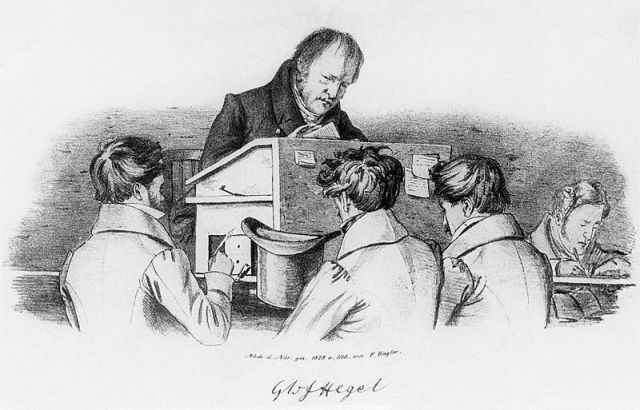
Hegel’s Scepticism

Hegel_by_Kugler_(retouched)

Hegel’s Phenomenology of Spirit is an exercise in scepticism.

People who call themselves “sceptics” often pride themselves on having their own ideas about the world, and trusting the evidence of their own senses. This is better than accepting established truths and arguments from authority. The sceptic says: Think for yourself!

But Hegel thinks that sceptics can be just as bad as those they criticise: holding fast to your ideas and impressions just because they are your own is no less dogmatic than holding onto ideas because you learned them in school.

For Hegel, real scepticism means being willing to let go of whatever ideas you have, however you acquired them. Few people are willing to be sceptics in this sense, because it means following a path of “despair,” where every belief you hold and cherish is held up for questioning and will, most likely, be cast aside as you progress.

But Hegel warns us to take care as we progress. It’s not as simple as throwing everything away until you are utterly free of beliefs. Nihilism can be a form of dogmatism. It can be a comfort to reject every truth as having no value altogether. Life becomes easy for the nihilist, who only has to find the negative in a thing in order to cast it aside, and never has to find the positive in anything.

Scepticism has value only if we also keep in mind the principle of “determinate negation,” which means looking for the positive in every negative. No idea or belief or impression is so false that it has no value whatsoever, and every negative result, every failure of consciousness to find the truth, can itself be turned into a new starting point. In other words: we can learn something from every wrong turn we make.

Determinate negation is the principle of the Phenomenology because it allows Hegel to proceed along the sceptical path of doubt while also constructing a systematic account of all the various errors that human consciousness can run into as it searches for the truth. Every time consciousness is proved wrong a new starting point is created from that failure, and so consciousness’s adventure can continue from where it left off, and the Phenomenology can recount its story.

(Image is from Wikimedia Commons.)

Posted in Hegel, Philosophy | Tagged , , , , , | 3 Comments

Notes on Henry Miller’s Nexus: Burying the Past

pocket-watch-3156771_1920

In Europe, Henry will acquire “a new body and a new soul”. Then he can make use of his experiences: what he has taken from New York, and from all his life so far.

We’ve seen throughout Nexus that Henry is never short of ideas. But they come so thick and fast that he can’t keep up, and his mind gets entangled. A new body and soul will mean he can finally make use of the ideas that come to him. He will be mentally and physically agile enough to keep up with them, and catch them, and bend them to his will.

It’s a spiritual transformation he’s looking for, not an intellectual one. He’s not going to understand life any better, but he will know better how to “drink of its undying essence.”

With his new body and soul he will acquire a new constitution, which will allow him to take life as it comes.

Heading out for his daily walk, Henry runs into MacGregor – a friend he’s been trying to avoid. He talks to him sharply, wishing he would “go to hell.” But now they’ve parted he’s feeling remorse for the way he’s behaved. He felt his friend needed some harsh words to stir him into action, but is that any way to talk to someone?

Get down off your high horse! he tells himself. He had blamed MacGregor for lacking any seriousness or purpose in life, but in doing so, he realises now, he’s overlooked the one thing they have in common: “plain ordinary human weakness.” It wasn’t for him to judge his friend, but to share in his suffering, to make life easier for him in that moment.

Looking back at his judgemental attitude he can see that he’s still trying to analyse and take apart life, rather than drinking of it unreservedly. Set aside judgement and what’s left? Compassion, love … all the things that make life worthwhile. To drink of that moment with his friend would have meant kindness rather than judgement.

Later it’s Henry’s turn to receive some advice. Sid tells him: “You’ve got to bury the past!” He thinks Henry’s success is certain if only he’ll look forward to it instead of remaining stuck in his old conceptions. Henry is always complaining about America and his own people, blaming them for all his ills. It’s not until he lets go of this bitterness that he’ll be able to move on to the next stage.

It’s ironic that this is the way to become a writer: burying the past to be able to write about the past. Once it’s buried you can unearth it in your own time. Carefully and deliberately. Master of the material now, rather than the victim of the painful memories.

I think this tension always existed in Miller – it’s this paradox that defines him: a demand for life, which means unreserved enjoyment, versus a demand for writing, which requires understanding and deliberation. Somewhere amidst the confused and contradictory statements Miller makes lies the truth of the matter. But can this truth ever be unearthed?

(Image is from Pixabay.)

Posted in books, Literature, Writing | Tagged , , , , , , | 3 Comments

Silence

tv-1844964_1920

When interviewed, Andy Warhol could appear aloof and arrogant. He famously preferred to give one word answers – usually “Yes” and “No” – or even just to nod or shake his head. He preferred even more not to give interviews at all.

When famous personalities behave like this it can seem that they consider themselves superior. It can make people dislike them.

In The Philosophy of Andy Warhol there’s a lot that seems sincere, amid all the jokes and absurdity that make the book so great. One thing Warhol says that I believe is how nervous he would get about TV interviews. I’ve never had my 15 minutes of TV fame but, from the small experience I have had of public speaking and performing, I can relate to what he describes: the constant silent mantra he repeats over and over “I’m going to faint. I’m going to faint. I know I’m going to faint. Have I fainted yet? I’m going to faint.”

Some people say it’s a good sign if you’re nervous. It means you care about what you’re doing. But it can make things really difficult too.

Warhol always said he wanted a TV show, and perhaps one of the less serious reasons he gives for not wanting to talk on TV is that he’s so jealous of the host for having a TV show that he can’t speak for the seething envy. Even if he’s just joking, I think we can see a human side to Warhol here: his lack of cooperation comes not from a sense of superiority but from inferiority. He doesn’t have a TV show of his own so he sees himself as a failure in this respect.

Andy Warhol says he likes “Talkers”. He admires them because they are creating something: all this talk. So rather than thinking of him sitting aloof there, we should imagine him enjoying the conversation around him, admiring the Talkers who, again, are managing to do something he’s incapable of.

By all accounts, Warhol could really talk when we was off the television. But talking on TV was something he just couldn’t do.

Somewhere – I can’t remember if it’s in this book or not – Warhol says he likes people who talk because it means he doesn’t have to. Again I can relate: who likes to carry the conversation?

Far from seeming alien or superior, Andy Warhol’s silence on TV now seems more like common sense to me.

(Image is from Pixabay.)

Posted in books | Tagged , | 2 Comments

To Own an Inch of Earth

moon-1859616_1920

Neal Cassady wrote to Jack Kerouac that when writing “one should forget all rules, literary style, and other such pretensions.” And what he wrote next was really beautiful:

“… Rather, I think, one should write, as nearly as possible, as if he were the first person on earth and was humbly and sincerely putting on paper that which he saw and experienced, loved and lost; what his passing thoughts were and his sorrows and desires …”

This seriousness of the task of writing that Cassady evokes is what I find so stirring in this passage: humility and sincerity are the virtues of the writer, and it’s by taking the task of writing seriously that you find real freedom in it.

According to Barry Miles, Kerouac was impressed with Cassady’s advice and took it to heart. Kerouac had already written a novel, but from now on he would write memoir: stories about what really happened, as close to the truth as he could tell them.

In his novel there had been a scene where three women – Mrs. Martin, her daughter Ruth, and a cousin called Leona – sit on the swing in the back yard under the moon. The cousin exclaims “Ooh! ain’t the moon grand!” at which point Mr. Martin mimics loudly from the kitchen: “Ain’t the moon gry-and!” And then when Cousin Leona has just sighed at the moon about “the irony of this life,” out charges Mr. Martin, again with his vicious mimicry: “Oh, the irony of liaf.”

Kerouac pours scorn on Mr. Martin, for having missed the significance of the moment, and for mocking something he didn’t understand:

“The women rock back and forth in the old creaking swing, reaching mechanically into the popcorn bowl, musing, contented, belonging to the wonderful darkness and the ripe June world, owning it, as no barging man of the house could ever hope to belong to any part of the earth or own an inch of it.”

What Mr. Martin was lacking was the humility and sincerity that’s required in order to belong to and own the present moment. Presumably, Kerouac had found himself lacking in that seriousness from time to time, as we all do too often. And so Cassady’s words resonated with him. Kerouac’s task as a writer now is to recapture, in the process of writing, that seriousness that enables a soul to own an inch or more of earth.

(I’ve been reading Jack Kerouac: King of the Beats by Barry Miles and The Town and the City by Jack Kerouac. The image is from Pixabay.)

Posted in Beat Generation, books, Literature, Writing | Tagged , , , , , | 6 Comments

Love and Understanding (Notes on Jack Kerouac’s The Town and the City)

Merrimack_River,_Franklin,_NH

To children and writers, a landscape presents mysteries to be contemplated rather than solved. Jack Kerouac opens his The Town and the City with a description of the course of the Merrimac River, its “broad and placid” flow “broken at the falls to make frothy havoc” until, foaming on, it “suddenly swings about in a wide and peaceful basin” before it disappears entering “an infinity of waters.” The river has flowed on and on for all time, fed by “endless sources and unfathomable springs,” and we, as readers, are invited to contemplate its mysterious endlessness.

A child sitting on the river’s edge is content to contemplate such a great thing, enchanted for hours and hours by the sight and sound of the water rushing by. A writer like Kerouac has the same childlike impulse: to simply watch, and be content to describe the endless movement of the river without ever solving its great mystery.

Grownups don’t have time for such things. They work in the factories pressed together in the midst of this landscape – “brick, primly towered, solid” – and when they do not work they eat and rest with their families. There are mysteries to be contemplated here at home too – for example, Francis Martin, George’s third child, who nobody can make out. He’s “always moping and sulking,” and it’s easy enough just to say he’s crazy. But his mother is more sensitive: “You can’t expect too much from Francis … He’s a strange boy, you’ve just got to understand him.” “Understanding” here to mean accepting the mystery, like “being understanding” rather than analysing the situation: Francis is who he is, and you’ve got to accept him for all his mystery, just like everyone else.

Writers, like children, have time for mystery, and so Kerouac would never just dismiss someone like Francis as crazy. Love and understanding are the basis of writing. Like the children described on the first page of Kerouac’s first book, sitting contented beside the river, we also must have the patience to simply enjoy the mystery of what is before us, if we are to acquire the true understanding of a writer like Kerouac.

(Image is from Wikimedia Commons.)

Posted in Beat Generation, books, Literature, Writing | Tagged , , , , , | Leave a comment

Getting into a Rut: Notes on The Philosophy of Andy Warhol

cat-2632886_1920

Andy Warhol writes about time spent alone – in a “rut”, as he calls it.

How he gets into a rut: “Go to my room, fluff up the pillow, turn on a couple of TVs, open a box of Ritz crackers, break the seal on a box of Russell Stovers, sit down with the latest issue of every magazine except TV Guide from the corner newsstand, then pick up the phone and call everybody I know to ask them to look in their TV Guides to tell me what’s on, what’s been on, what’s going to be on. I also enjoy rereading the newspaper.”

Sometimes people call him up when he’s alone like this, to talk about business. They always apologise for interrupting his rut. “They know how much I like it,” he says.

I think “rut” is such a good name for it. It makes me think of dirt, and I do always feel sort of grubby after a long enough time spent wallowing in the sort of way Warhol describes. Today it’s box sets and instant messaging.

I think Warhol explains well why time spent like this is so enjoyable. It comes down to the fact that when you’re not doing anything then it seems like time isn’t moving, and life might continue forever like this.

When time moves, things happen: new people, new problems. Warhol likes to keep things standing still for as long as possible.

Warhol doesn’t have much to say about death: his chapter on the subject is only a paragraph long. So perhaps he isn’t worried about that. Rather than trying to make himself immortal by doing nothing, Warhol is just trying to stop any more things happening for a while.

Warhol isn’t afraid of death, but he is afraid of “problems”: he just wants life to be as easy as possible.

Time spent in a rut is an intermission, or an “innermission”, he writes. You retreat into yourself, into an inner space where nothing is happening. Things only happen out there, in the world. If you’re here, where nothing is happening, then time isn’t moving, and you won’t have any problems for a while.

If you go out and do things, like going around travelling all the time, then life is going to move really fast. “I don’t like to travel,” writes Warhol, “because I really like slow time and for a plane you have to leave three or four hours ahead of time, so that’s a day right there. If you really want your life to pass like a movie in front of you, just travel, you can forget your life.”

Life is the opposite of a movie, for Warhol. Life shouldn’t just flash by. This explains why Warhol’s movies were so un-movie-like: he wanted to capture life, passing by slowly, so you almost can’t tell time is passing.

In his painting he aims for “quantity” above all else, he says. Doing the same thing again and again is the ideal: it’s easy, and there are no problems. Repetition is a way of staying in the same moment.

When we talk of someone “getting into a rut”, we usually mean to say: that person has a big problem. They’re stuck and they can’t get out. What Andy Warhol explains is that the reason we get into our ruts – to begin with, at least – is that they can seem like the perfect way to avoid the problems of the world altogether.

(Image is from Pixabay)

Posted in books | Tagged , , | 7 Comments

Take Heart (Notes on Henry Miller’s Nexus, Chapter 11)

angel-564351_960_720

Henry Miller falls asleep and has a dream, and that dream becomes a vision. He awakes to see the world with new eyes.

It begins with one of those lucid dreams where anything is possible:

“Nothing I wished to do required the least effort. If I wished to run, whether slow or fast, I did so without losing breath. If I wanted to jump a lake or skip over a hill, I simply jumped. If I wanted to fly, I flew.”

But this pleasant state of absolute freedom is soon transformed, to be replaced gradually with a frightening vision.

He realises he is not alone. There is a presence at his side. “My guardian angel, most likely.” He finds that he can communicate with everything he comes across – animals, plants, rocks – with the presence at his side enabling him to understand and be understood. This would be something to enjoy, but Henry has a feeling of foreboding: he is being “escorted” to some “realm”, for a purpose he cannot understand.

He becomes slowly aware that he is wounded and bleeding, from head to toe. The one who is with him tends to his wounds, but Henry is afraid. Is he about to die?

He looks for the first time to the one tending him. He is reassured by the look of compassion on her face. He begins to have no concern for the world: if he is going to die then he will accept it. “A feeling of peace invaded my being, and again I closed my eyes.” His acceptance of fate gives him “a new vigour”.

But with this new vigour he notices, in contrast to the power he feels in his new body and mind, that there is one place he is still lacking: his heart. Placing his hand there he realises: “To my horror there was a deep hole where the heart should have been. A hole from which no blood flowed.”

It is here that he sees the vision proper: his whole life flashing before him, in a way “no man should be permitted to see until he is ready to give up the ghost.” He sees what a villain he has been, so afraid of getting his heart broken that it shrank and shrank and “dwindled from disuse.”

Without a heart, Henry was invulnerable. But at what cost? “The sense of the utter emptiness of existence overwhelmed me. I had achieved invulnerability, it was mine forever, but life – if this was life – had lost all meaning. My lips moved as if in prayer but the feeling to express anguish failed me. Heartless, I had lost the power to communicate, even with my Creator.”

And then the Angel restores Henry’s heart, holding it before him until it grows full of blood again. “My transgressions had been forgiven; I was free to sin again, free to burn with the flame of the spirit.”

Free to sin again. Knowing he is a sinner he can let himself go and follow his instincts, knowing that his guardian angel watches over him. “What joy now possessed me! What complete and absolute trust!”

Henry Miller had thought his heart was broken – it turns out it had merely shrunk. It shrunk so that it might be safe from breaking. He had made it small and invulnerable. He had made himself invulnerable, by hiding his heart away.

When you’re invulnerable you have no need for a heart. And all meaning in life is lost. Inhuman and heartless. Waking from his dream, Henry Miller is now glad to be human and vulnerable. A madman, shouting at passers-by: “Take heart, O brothers and sisters! Take heart!”

Miller will go through many of these transformations, shrinking and growing and shrinking again. Like a bad pupil he never learns his lesson for long, and starts to shrink again – but fortunately for him he is a man to whom visions come easily, his guardian angel always ready to set him on the path again. One of the reasons Miller can be so inspiring is not so much that he was a great writer, but that he was a weak individual, who was ready to confess his weaknesses, and who succeeded by the grace of God.

(Image is from Pixabay)

Posted in books, Literature | Tagged , , | 3 Comments

Notes on Dante’s Paradise, Canto 3

“… think carefully what love is and you’ll see …”

This line hands you the key to the poem, if you haven’t picked it up already. The universe of Dante is a hierarchy, where every individual’s place in the order is determined by the love in their own heart.

Dante has asked the spirit – luminous shade barely visible against the silver light all around – Dante is standing inside the shining sphere of the moon – How can you be happy here in the lowest realm of Paradise? Knowing as you do that God’s light shines more brightly elsewhere, in the upper regions of Heaven that you will never see.

The spirit answers that it is because they love God that they accept their place in the hierarchy. They do so not grudgingly. They accept their place because it is right.

Lower down, on the mountain of Purgatory, the pilgrim might have noticed the same thing going on. The path up the mountain is there for all to walk on, and yet the spirits remain on their terrace and suffer their punishment, and do not continue up. Why not? We are told: it is because they lack the will to do so.

Just as in life they were shown God’s love but chose to distract themselves from it – perhaps pursuing worldly wealth, or vengeful dreams against neighbours, or gluttony for food and drink – so here in Purgatory they lack the will to face God’s light.

They are unwilling to enter Heaven for now. They will remain here on the mountain and be purged of their sins, and then with a thunderclap they will suddenly find their will returned to them – it was there all along, perhaps they can remember as children having felt a pure love of God – and suddenly they can journey up the mountain.

To seek is to find – to want to know God’s love is to know it. And so when the Earthly Paradise is reached at the top of the mountain, and the pilgrim is ready to enter Heaven, he ascends like an arrow from a bow. He’s beamed up to Paradise by an act of sheer will.

By God’s grace, since it was God that gave you that free will.

Compare these blessed spirits on their journey to Paradise with those that Dante met in Hell, those who will forever remain shut away from God’s light. They too have chosen, and find their place in the order of things determined by the love they hold in their own hearts. Self-love keeps them there in the dark, hearing nothing but the continual sound of their own cries. They will never find the will to enter Heaven, having buried themselves firmly in their own sin.

The cruelty of a system that includes eternal punishment might seem staggering. It seemed so even to Dante, that medieval man himself, who at first showed pity to the shades in Hell and was rebuked by Virgil for it. To pity the damned is to deny the justice in the will of God, says Dante’s guide, and is itself a sin. It is not our place to understand God’s justice. Only to believe in its rightness.

I think it’s futile to try to argue with the medieval minds we encounter. They won’t listen to reason. Better for us to listen to the stuttering of these alien souls – and perhaps we’ll notice the resonances in our own faltering logic. Our own cravings for authority, order, and judgement. And, in noting the distance of centuries that lies between us and Dante, perhaps we’ll come to question those modern impulses we find in ourselves that we are so quick to condemn in souls that we call “medieval.”

(I’ve been reading Dante’s Paradise, translated by Mark Musa. The line quoted at the beginning is Canto 3, line 76.)

Posted in books, Literature | Tagged , , , , , , , | Leave a comment