Stone and Space

Being

“The worked stone . . . has considered limits and measured form; what it is is what it has become under the sculptor’s chisel.”

The statue wants nothing, it rests upon the ground, complete and beautiful. It is what it has become.

Nothing

“The symbolising of extension, of space . . . and we find it alike in the conceptions of absolute space that pervade Newtonian physics, Gothic cathedral interiors . . .”

Unlike the statue, the cathedral yearns, it rises up into space, a place of longing, we notice less the worked stone and more the sheer vastness of it, how high that vaulted roof above us. Vast emptiness. It tells us of the infinite spirit of God, of infinite possibility for humankind, and of our own yearning.

Becoming

“It was principally in Germany that the organ was developed into the space-commanding giant that we know, an instrument the like of which does not exist in all musical history. The free organ-playing of Bach and his time was nothing if it was not analysis – analysis of a strange and vast time-world.”

Analysis, untangling the emptiness to find a world within it. Commanding the void to bring forth the world that it contains. But the emptiness stretches on and on, rises up and up. Can it ever be filled? The analysis continues. The music continues to bring its light and order and energy to the endless space. Sometimes as we listen to the organ play it seems for a moment that the world is indeed full of light. God breathes among the arched and tangled stonework, and we feel the vibration of the cosmos.

(I’ve been reading The Decline of the West by Oswald Spengler, the abridged edition published in 1991, translated by Charles Francis Atkinson.)

Posted in Spengler | Tagged | Leave a comment

Salut Au Monde!

Walt Whitman was a writer of light and vision. He invites us to see: cloud-topped mountains, great lakes and rivers, the oceans and those who sail on the ocean, the many different countries of the earth and the people that dwell in them.

In “Salut au Monde!” he shows us the many different homes of the people of the world: “I see distant lands, as real and near to the inhabitants of them as my land is to me.” Real and near, this is what a person’s home is. Real because it is near and familiar. My home is the reality in which I dwell.

Sometimes I feel discomfort when I stray far from home. Things start to seem unreal. Foreign customs, expressions, points of view: all contribute to create a sense that the earth has slipped from under my feet. This is because what I call “real” is just what is familiar to me: I call things “known” and “true” because I am accustomed to them being this way.

But Whitman, as he soars and glides around the world, looking in on the various forms of human life, becomes “at random a part of” these homes. Whitman, poet, is able to make his home anywhere, just for a time. And it is because he is a poet that he can make his home anywhere. The magic that allows him to fit into these homes, to live anywhere however alien the life might be to him, is the magic of respect and love, his respect and love for all human life. He is at home wherever he can find “equals and lovers”, and he can find these in any part of the world. The humanity of the earth is one. As a poet he knows that you don’t simply have a home: you make one. A poet, a maker, is able to do this wherever he or she goes. And conversely: when a poet meets another soul, the poet is able to make a home for this other person, to express the love and understanding that men and women all over the world have in common, so that, looking into the eyes of the poet, you are reminded again, whoever and wherever you are, that you belong in friendship together on the earth.

Posted in Literature | Tagged , | 1 Comment

Notes on Allen Ginsberg’s “Howl”

Allen Ginsberg gives us picture after picture of the lost minds, “the best minds of my generation”, images of entire lives lived and lived out and used up, flashes of light and life like the images in Whitman, who also gave a great catalogue of the souls that make up the soul of America. But Ginsberg’s is a vision of doom, of lives driven to madness and slavery.

“Moloch”, the god of America now, bashes in their brains and robs them of imagination, so that for all the opulent variety of these many souls so many will be crushed or drained that there will be nothing but a drab windowless uniformity, grey walls grey opinions, passive acceptance of war and child-murder and police control and gratitude even for their own slavery, even as they weep for their lost innocence and youth, even as they hardly realise what they weep for.

If Moloch hasn’t defeated you, if you’re still alive with imagination and hope and vision for mankind then you’re among a fortunate few. But it’s enough. Even to know one other soul to call to, across the abyss, is enough. Ginsberg calls to Carl Solomon: “I’m with you!” And together they can be great writers, even just in their own minds, since they share a vision and even work together at the same great typewriter.

And even among the worshippers of Moloch, you can if you believe in your own great and vast and singular vision see that “everything is holy!” And just to share this one truth – shout it: “Holy! Holy! Holy!” – is the entire business of art in these times.

Posted in Literature | Tagged , , , , | 3 Comments

Decline according to Spengler

Oswald Spengler tells us that Western civilisation is in decline. This doesn’t mean the end is nigh, this doesn’t mean the end of days. We have centuries left, and when civilisation as we (in the West) know it finally comes to an end, by then there will be another living culture to replace it. But what we must not do is imagine that Western civilisation will continue forever. The very fact that Western civilisation imagines that it will continue forever is a symptom of its decline.

Spengler tells us that when a culture is in decline is becomes imperialistic. It seeks to expand. It no longer looks inward as much as it looks outward. Late Western “creative possibilities” are “extensive”, and no longer intensive. Cecil Rhodes is an early example of this late Western man, says Spengler: his ambitions were large and outward looking, he wanted to leave a legacy, he wanted to build grand projects . . . This is all a sign of the decline of a culture: imperialism is always a signal of death. Rhodes was a “brain-man”, a calculator, an opportunist: he’s finished reflecting, peering into his own soul, and found little enough to look at in that direction. Now he calculates how best to make a grand and profitable impact on the world.

“Life is the process of effecting possibilities, and for the brain-man there are only extensive possibilities.” It seems obvious to us in the West that everything must be bigger, faster, and more connected, but in fact (Spengler tells us) this is something specific to our culture in this late stage. It’s the very substance of what it means to us to be creative in our culture. Imperialism doesn’t just mean brutal and bloody wars: it means desiring to build, and to build without end, it means making bolder and faster and brighter creations – even art and philosophical thought is affected by this trend – you need to be “great,” you need to make an “impact” . . .

What is it that we believe we are achieving through this endless expansion? The short answer is: immortality. We no longer believe that our own souls are anything much to look at, we don’t need to look inward for long to take in the sum of metaphysics, and any talk of an immortal soul is nonsensical to us. We’re obsessed now by the fact, as we see it, that each life is doomed to end, and end forever. And so we’re attempting to build our own immortality – a railway to last forever, irrefutable ethical systems to guide us for all time, space colonies expanding outward toward the infinite . . .

As a culture, it’s our obsessions that define us. And our obsession, as our own culture begins to die, is with death itself.

(I’ve been reading The Decline of the West by Oswald Spengler, the abridged edition published in 1991, translated by Charles Francis Atkinson.)

Posted in books, History, Literature | Tagged , | 2 Comments

Some notes on Spengler as I read him

I’ve been slowly reading The Decline of the West by Oswald Spengler with a couple of friends. We meet online once a week to discuss the pages we’ve read. What follows is an explanation of Spengler as I understand him so far, though I expect to find I’ve missed many nuances and even got some of this completely backwards. If there are any Spengler enthusiasts out there who would like to offer corrections I’d be very grateful. Meanwhile I’ll stumble on.

In the book, Spengler is looking for the meaning of this period of history: c.1800-2000, West Europe and North America (Or the “West”). Notice this period is defined spatially as well as temporally: according to Spengler’s strange concept of historical development, we in the West don’t really belong to the same period as those in c.1800-2000 China, c.1800-2000 India, and so on. Our culture has its own life and specificity, and it is really useless to lump together all the cultures in the whole world when trying to do history, since study of history is study of the life of a culture. (This makes Spengler’s notion of what it means to do “world-history” an interesting and paradoxical one, but this is a story for another time.)

So what is it that defines c.1800-2000 West? According to Spengler, it’s our view of the Classical world: Greece and Rome. We in the West have a special relationship with Greece and Rome, as no other culture has had with another culture. Spengler says we have projected our own spiritual concerns onto Greece and Rome and understand ourselves through them. So what is it about them?

Spengler tells us that, viewed correctly, Greece and Rome have a parallel development to Western culture. Greece created a culture of living forms – myths, gods, artistic techniques – and the Romans inherited these forms but added nothing to them so that the forms died, but were preserved in death. Though Rome might appear to be a continuation of Greek culture, in fact Roman civilisation merely preserved Greek culture, using Greek religious and artistic symbols as it continued its business of conquering the world. Rome was a “civilisation” and not a living “culture” of its own, in Spengler’s eyes, because it turned away from creating living forms and instead focused on the forms of living death: money and power.

We in the c.1800-2000 West are in a “Roman” phase, we might say. All the great cultural innovations have passed – political ideas of freedom as self-determination and absence of slavery (liberté), inventions such as the printing press as symbols for a levelling of society (égalité) the spiritual ideas of Christianity preserved in a humanistic form (fraternité) – and now c.1800-2000 we hold onto these ideas in their fixed forms as we worry about how to make ourselves richer and more powerful. Hence you can explain all recent wars in terms of economics, and the “freedom” that our leaders often claim they are promoting by their wars is the 200 year old notion of freedom that came out of our culture while it still lived. We no longer live within this notion of freedom, since we don’t often trouble ourselves to struggle with the difficult concepts of freedom as philosophers did while our world was still inflamed by the impact of the French Revolution: we tend to accept these philosophical ideas passively and hold them up as relics of a past that we are proud of. Now these ideas exist merely to preserve our more mundane and mercantile purposes.

So this is the import of that word in the title of Spengler’s book: “decline.” Just as the Roman Empire brought about the end of Greek culture, but then continued for centuries to spread even though it had stopped developing, so the West of c.1800-2000 has brought its own past cultural development to an end, and though Western civilisation will continue for a long time, nothing new can come of it. Strive for money and power by all means, Spengler seems to be saying, since this is what it means to live in the c.1800-2000 West, but don’t expect to produce anything new and wonderful by this. If you want to see where we’re heading, Spengler is suggesting, just take a look at the history of the later Roman Empire and you’ll get some idea.

Posted in books, History | Tagged , , | Leave a comment

Cloud Mind Shadow

“I believe that only a dreamer who has fear neither of life nor death will discover this infinitesimal iota of force which will hurtle the cosmos into whack – instantaneously.”

What do you do when you have no fear of life and death? Perhaps you sit outside a quiet pub and drink a beer on a mild September afternoon. And dream. This moment belongs to you: a moment to do nothing. You live a lifetime in such a moment.

“For him who is obliged to dream with eyes wide open all movement is in reverse, all action broken into kaleidoscopic fragments.”

The ideologues have it in reverse, with their emphasis on seizing opportunity: if you keep your eyes open for every opportunity to act (to “get on”, to “add value”) then you’re living like an animal. Gilles Deleuze said that this is what it means to be an animal: always on the lookout, always on alert. If you live like this you’ll never know what it can mean to be human, a rational being whose mind encompasses the earth and sky, and the cloud rolling above and shadows that move below are this human beer-drunk mind moving away and back into itself. If you live for opportunity you will remain warily separate from the human nature-mind of cloud and shadow. Clouds mean rain, shadows mean danger. Keep your eyes open.

“I believe, as I walk through the horror of the present, that only those who have the courage to close their eyes, only those whose permanent absence from the condition known as reality can affect our fate . . .”

On every inhabited planet in every galaxy of every universe is the same “identical misery . . . identical insanity.” It will be back to the same insanity once I finish this beer. But for now everything seems in order. The cosmos? It’s all in whack as long as I can sit in this peace in the cool air. A moment alone with myself. A lifetime before the deluge.

(I’ve been reading Black Spring by Henry Miller, published by Alma Classics in 2012. Most of the quotations in this post are from the chapter entitled “Walking Up and Down in China.”)

Posted in Fiction, Writing | Tagged , , , | Leave a comment

The Garden Pool

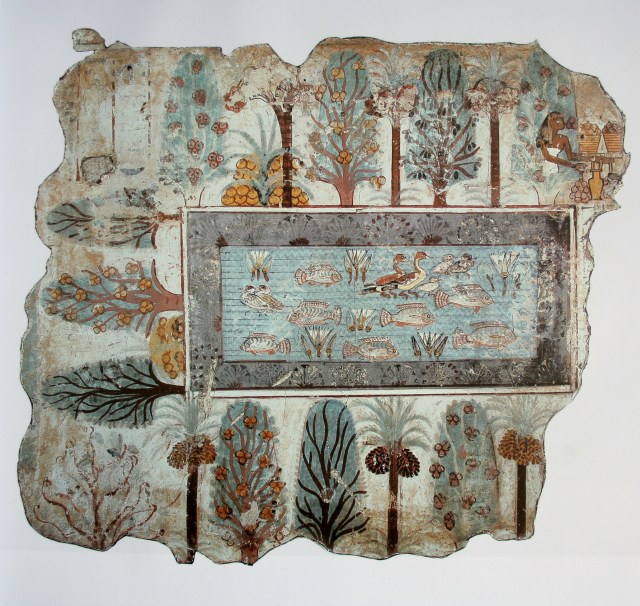
(Painting from The Tomb of Nebamun, 18th Dynasty Egypt)

 le_jardin_de_nebamoun

“Viewed from above, as if through the eyes of the gods”

To the eyes of a god the world appears flat. The trees lie flat around the flattened pool, and the ducks and fish lie flat on a water that is all surface. And the goddess sits in the same corner carrying out her work setting out the fruit and water she has collected that morning. She moves too fast for the god’s lazy eye-blink and he finally sees her only when her task is almost done. Each day the same, the goddess ready with the fruit and water.

The goddess’s task is easy: the fruit falls ready from the trees. Each day the feast is prepared – but for whom? The god never sees: his gaze is moving on past the garden just as the guests arrive.

(I’ve been reading 1001 Paintings You Must See Before You Die, published by Cassell in 2006. The quotation in italics under the picture is from there. I found the picture itself on Wikimedia Commons.)

Posted in books, History | Tagged , , | Leave a comment

Reading Spengler Again

This preface I’m reading says I shouldn’t be literal-minded when reading Oswald Spengler. Yes, his presentation of the facts is dubious, he exaggerates and distorts, he’s polemical – but I mustn’t let this spoil my enjoyment. I’d be missing out on something important if I gave Spengler a miss on the grounds that he’s imprecise about historical detail. But how can I read a work of this kind and not be literal-minded? Shouldn’t I evaluate a work of history on the basis of whether it’s true or not? Of whether it gets the facts right?

The author of the preface I’m reading invites me to compare Spengler to Arnold J. Toynbee. Toynbee took great pains in his empirical approach. He appears “more precise” with his data, and “more reasonable” in his tone. But ultimately this was just an appearance: he is “as dogmatic as Spengler.” Behind Toynbee’s apparently reasonable claims are Christian assumptions, and he effectively “composed . . . a history of salvation.”

At least with Spengler the assumptions are there on the surface. But how can these historians be so subjective, so free with the facts? The preface I’m reading seems to suggest that the trouble is they’re not really doing history at all, but anthropology, or “cultural comparisons across time and space.” Or perhaps in Spengler’s case, it’s suggested, what he’s really written is a kind of poetry: Spengler, after all, referred to himself as a poet. Maybe there’s something about cultural comparison that lends itself to a poetic approach, rather than a scientific one: a rational or scientific approach demands that we begin with a set of underlying principles, and which principles can we begin with that could be universally applied to all cultures? If you are a poet, on the other hand, you accept that you are looking with your own eyes, that the truth you see is your own. Though he says “thinker,” Spengler sounds like he’s describing a poet when he writes:

“A thinker is a person whose part it is to symbolise time according to his vision and understanding. He has no choice; he thinks as he has to think. Truth in the long run is to him the picture of the world which was born at his birth.”

And the paradox seems to be, that once you acknowledge that your vision is your own, that you are describing the world as you see it and not from a god’s eye view, you begin to see the object more clearly: it shines and stands apart as you describe it, and through your work, if you write well, the simple truths of the world become clear and visible to the attentive reader.

(I’m reading The Decline of the West by Oswald Spengler, an abridged edition from the translation by Charles Francis Atkinson, published by Oxford University Press in 1991. The preface is by H. Stuart Hughes.)

Posted in History, Writing | Tagged , , , | Leave a comment

Dostoevsky, Death and Paradise

Why write? Not to create original truths, but to remind ourselves of old truths. We need to be reminded: we are forgetful. Original stories to remind us of what we’ve always known. The history of humanity, and the duration of a life, is the coming round and round again to what we already knew in the beginning: that the mind is the body, the moment is eternal, and each day is a paradise.

In The Karamazov Brothers, there’s a story of a young man who is dying. Having been an atheist until now, he begins to go to church – he says he does it to please his mother, who fears for his soul. He’s too ill to go to church for long, and now he must confess and take the sacrament at home. And one day it becomes clear that a change has come over him: “his spirit seemed transformed.” He no longer fears death. He has a serene look in his eyes, he smiles at everyone. He weeps to see the innocence of the birds in the garden. He blesses the sunrise each morning, and declares that we live each day in paradise. Blissful and serene, the whole house feels the joy of his transformation. The doctor says he won’t live much longer: the disease is affecting his brain.

Dostoevsky reminds me of what I, like the doctor, have forgotten. What I learn and forget and learn and forget again and again: that life, like a well-written story, is simple. That you only live the day you are living. That the sun is a blessing, a gift, and so every day the world gives you something for nothing. These are eternal, simple truths. Truths that must come to mind when faced with the beauty of a simple story, or, I imagine, with the sublime finality of death itself.

(The story of the young man is at the beginning of Book Six of The Karamazov Brothers, by Fyodor Dostoevsky. I’ve been reading the translation by Constance Garnett, published by Wordsworth Classics.)

Posted in Literature, Writing | Tagged , , | 6 Comments

The Very Last Love in the World

Vladimir Mayakovsky’s “The Backbone Flute” is a poem about desire, the mystery of where desires come from, and how they can fade and be forgotten. And it’s about the suffering of an artist, a poet, whose desires seem too wide for the world.

The poet depicts himself at work where

“the nails of words

“nail me to paper”

Nailed to paper in the dim light of his study. But we should not just imagine the poet here hunched over his writing paper, but also leaving his house, out in the street, still carrying the grey darkness of the study with him. The words, his own words, are still driven through him. Crucified, he is held in position. Boris Pasternak wrote of Mayakovsky: “His way of carrying himself suggested something like a decision when it has been executed and its consequences are irrevocable. This decision was his very genius . . .” The poet has created himself according to his own decision, his own genius, and his very being is now determined by this decision, the decision made in the dark of his study. He’s heavy with his genius.

Outside, the streets are full of “gaiety.” Light and laughter threaten to penetrate his self-enclosing gloom. Nature turns green and gold with spring. “Flowers and grasses, turn gold in the sun!” But, being crucified, the poet can only look inward at his own words, his own suffering:

“I desire only one poison –

“to drink the deep draught of verse.”

And by this draught the poet’s gloomy genius is hardened, impenetrable.

He leaves his study and steps outdoors, to visit the woman he is in love with. She is a creature who has forgotten how to desire, with “the gaping hollows of two deep graves” for eyes. He feels he might fall into these graves, but he saves himself, “juggling with words” as he “totters above” first one abyss, then the other.

He wants to save his beloved from her own emptiness: “Find your youth in my soul,” he tells her. It’s strange that one who spends his days nailed to paper, hidden from the warmth of the life-giving sun, blind to the cheerfulness of the street, should feel he has a youthful soul, a soul so overflowing with youth that he has enough to spare to save the soul of another. But this is something of the magic of the “crucifixion” of the writer: he’s reborn, resurrected, and thereby immune to nature’s cycle of birth and decay.

She, however, is dead (even as she lives.) And the world is loveless: people have forgotten even that the sky is blue. Perhaps the poet’s love is the last love in the world, and the flush of his cheek is the last red in the world:

“the very last love in the world

“to dawn like a consumptive’s flush.”

The poet doesn’t expect his reader to understand. To him, we are all like this woman: dead to our desire. There is no desire left in the world, and you must go beyond the world, be otherworldly, to find your desire. The poet is superhuman in comparison to his lover, and in comparison to everyone else, all of us:

“If you carry your faltering steps to a bridge,

“thinking

“how good to be down there –

“then it is I,

“the Seine pouring under the bridge,

“who call you,

“baring my rotted teeth.”

Reborn with spring, the poet is the shadow of nature. A dark imitation. A river to call you down to your destruction. The work in the dark study, the dark magic of the crucifixion, has created this power in him. You are empty of desire, and so the poet can create desire within you. You are unable to resist. Stripped of your own desire, you are a blank canvas to be sketched upon:

“then it is I, climbing high,

“expectant and stripped like the moon, who make you yearn.”

You have forgotten how to desire. And so the poet will draw you down to despair, or raise you up to sublime yearning. The poet says: if you have no desire of your own, then I will create desire in you. I will lend you my youth, or make you desire death, or make you weep at the expectation of an impossible desire. You will see the world as I see it because, empty of desire, what is there in you to offer the least resistance? You’ll be filled, an empty vessel.

But perhaps the poet, like us, is not his own master. Perhaps not godlike after all. The only godlike one is God Himself. After all, it was God who put him in this position, and made him desire the woman he now loves. Made him want to nail himself to paper and give away his youth, rather than enjoy the joys of spring. The poet despairs and addresses God, God the greatest of all artists:

“remove that cursed woman

“whom you have made my beloved!”

But “the streets are too narrow for the storm of joy.” If God makes us desire, then why did He make the world, the streets, so narrow? Too narrow for this joy that the poet feels. There’s a moment in the poem “The Cloud in Trousers” when Mayakovsky expresses the same thought: God, if you are so good, then

“. . . why didn’t you see to it

“that one could without torture

“kiss, and kiss and kiss?!”

What use is this desire to kiss and kiss in this world so empty of desire, so narrow and constricting? Why must a poet drive nails into himself and shroud himself in darkness to communicate with the woman he desires?

Perhaps the answer is: God loves artists most of all. And He knows that an artist must suffer. And so he blesses His favourites with desire, knowing the suffering this will bring. It’s fitting that the instrument the poet chooses is his “own backbone”: the backbone God gave him. “The backbone flute”: an imperfect instrument, and one that only a poet, one meant for suffering, would dare to try to play. Needs to try to play, inspired by God to desire his own crucifixion.

(Quotations are from Vladimir Mayakvosky’s The Bedbug and Selected Poetry, translated by Max Hayward and George Reavey, published in 1975 by Indiana University Press. The quotation from Boris Pasternak is found in the introduction, written by Patricia Blake.)

Posted in Literature, Writing | Tagged , , | 2 Comments